What to Do When You Profit from Binary Options? Tax Return Standards and How to Calculate Your Taxes

Are you wondering, "I made a profit from binary options, but what about taxes?" This article explains binary options tax issues in an easy-to-understand way for beginners, covering everything from proper tax return filing to tax-saving strategies...
Try a free demo now
Experience the real trading environment without using real money
Are you wondering, "I made a profit from binary options, but what about taxes?"
- Is a tax return necessary or not?
- Are taxes different for overseas and domestic brokers?
- What happens if unreported income is discovered?
This article explains binary options tax issues in an easy-to-understand way for beginners, comprehensively covering everything from proper tax return filing to tax-saving strategies.
Understanding the Basics of Binary Options Taxation
Profits from binary options are subject to taxation, but the tax system varies significantly depending on the type of broker and trading conditions. It's crucial to accurately understand which tax system applies to you. [What you'll learn in this chapter]
- Income classification = classified as miscellaneous income; domestic uses separate taxation, overseas uses comprehensive taxation
- Tax rate calculation = combined with employment income and progressive tax rates applied
- Profit/loss offsetting = stock investments are calculated separately
Binary Options Are Principally Taxed as "Miscellaneous Income"
Profits from binary options are classified as "miscellaneous income" under tax law (Reference: National Tax Agency). Profits from domestic brokers are subject to separate self-assessment taxation, while miscellaneous income from overseas brokers is subject to comprehensive taxation, meaning the tax rate is determined by combining it with employment and business income.
How Tax Calculations Work with Progressive Tax Rates
When subject to comprehensive taxation as miscellaneous income, progressive income tax rates apply. Income tax rates are divided into 7 tiers from 5% to 45%, and the tax rate increases according to income level.

Source: National Tax Agency "Income Tax Rates"This rate is for income tax only; an additional 10% resident tax is also applied, making the actual tax burden even heavier.
Cases Where Profit/Loss Offsetting Is Not Possible
Overseas binary options (miscellaneous income under comprehensive taxation) and domestic FX or domestic futures trading (miscellaneous income under separate taxation) cannot be offset against each other because they fall under different tax categories. However, offsetting is possible within other miscellaneous income classified under the same comprehensive taxation (e.g., cryptocurrency, affiliate income, etc.). Additionally, profit/loss offsetting with FX and futures trading profits is possible. Furthermore, loss carryforward deductions are also permitted.
Scope and Conditions for Expense Deductions
Expenditures related to binary options trading can be claimed as necessary expenses directly required to generate trading profits.
- Computer and smartphone purchases for trading, plus communication costs
- Books and publications related to binary options
- Seminar fees and transportation costs related to trading
- Trading fees and paid tool subscriptions
- Entertainment expenses related to trading
When equipment is shared for personal and business use, proportional allocation and proof of business relevance are often required, and it's important to note that the burden of explanation to the tax office lies with the investor.
When Tax Returns Are Required and How to Determine Your Obligation
Tax return obligations vary greatly depending on your occupation and other income sources. It's necessary to have an accurate understanding based on your situation. [What you'll learn in this chapter]
- Salaried employees = filing obligation arises when side income exceeds 200,000 yen
- Homemakers = subject to filing when annual income exceeds 480,000 yen
- Self-employed = all income must be combined and reported
- Penalty risks = non-filing surcharge up to 20%
[Salaried Employees] 200,000 Yen Per Year Is the Threshold
For salaried employees, a tax return is required when income other than salary exceeds 200,000 yen annually. This is determined not only by binary options profits but also by the total including side job income and other miscellaneous income. Note that the key point is profit of 200,000 yen or more after deducting expenses.
[Homemakers/Students] The 480,000 Yen Basic Deduction Is the Threshold
Homemakers and students without employment income must file a tax return if annual binary options profits exceed 480,000 yen. For example, if average monthly profit is 40,000 yen, the annual total is 480,000 yen, so no filing is needed. However, if annual profit after deducting expenses exceeds 480,000 yen, be sure to file a tax return.
[Self-Employed/Freelancers] Filing Is Always Required
Sole proprietors and freelancers must combine all income for tax filing, so binary options profits must always be reported regardless of the amount. Business income and binary options income are calculated separately, but the combined amount determines the tax rate. In years when business profits are high, the tax rate on binary options profits will also be higher - keep this in mind.
Risks and Penalties of Failing to Report
The tax office can investigate binary options trading through bank transaction records. If unreported income is discovered, severe penalties including a non-filing surcharge (15-20%) and delinquent tax (7.3-14.6% annually) apply. Even if you use overseas brokers, Japanese tax law requires reporting. Thinking "they won't find out because it's an overseas broker" is dangerous, as there's a risk of substantial additional taxation later - make sure to file properly.
Thorough Comparison of Tax Systems for Overseas vs. Domestic Brokers
When choosing a binary options broker, tax differences have a major impact on investment returns. Since domestic and overseas brokers are subject to different tax systems, understanding this in advance is important. [What you'll learn in this chapter]
- Domestic broker tax system = separate taxation at a flat rate of 20.315%
- Overseas broker tax system = comprehensive taxation with rates up to 55%
- Loss carryforward = only available for domestic brokers for up to 3 years
- Impact of tax system choice = advantages vary by income level
[Domestic Brokers] Separate Taxation at a Fixed Rate of 20.315%
When using domestic binary options brokers (GMO Click Securities, Gaitame.com, etc.), a flat rate of 20.315% (15% income tax, 5% resident tax, 0.315% special reconstruction income tax) applies to profits. The rate remains the same regardless of profit amount, making it advantageous for high-income earners. Loss carryforward and profit/loss offsetting are also available. The higher your employment income tax rate, the greater the benefit of using domestic brokers.
[Overseas Brokers] Risk of High Tax Rates Up to 55% Under Comprehensive Taxation
BI-WINNING and other overseas binary options brokers' profits are subject to comprehensive taxation, with rates ranging from 5% to 55% depending on the combined amount with employment income. Loss carryforward deductions are generally not available. If total income is less than 6.95 million yen, overseas brokers may have a lighter tax burden, but otherwise, the flat rate of domestic brokers is more advantageous.
[Loss Carryforward] A Major 3-Year Advantage
The biggest advantage of domestic brokers is the system that allows losses to be carried forward for 3 years to offset against future profits. This can reduce the total tax burden across multiple fiscal years. To receive carryforward deductions, you must continue filing tax returns every year during the carryforward period, not just the year the loss occurred. Even if you incur losses in the first year, your taxes are reduced when profits are generated later, providing a tax-saving effect.
Which Should You Choose? Decision Criteria by Income Level
Tax advantages and disadvantages vary significantly based on individual income levels. If your annual income is 4 million yen or less, overseas brokers are more advantageous; if 5 million yen or more, domestic brokers offer better tax benefits.
Income Level | Advantageous Choice | Reason |
|---|---|---|
4 million yen or less | Overseas brokers | Progressive tax rates under comprehensive taxation are lower, reducing the rate for lower-income earners. |
4-5 million yen | Case by case | Tax advantages depend on profit/loss situation and other income sources. |
5 million yen or more | Domestic brokers | The flat 20.315% separate taxation rate is lower than progressive taxation, favoring high-income earners. |
However, it's important to consider not only tax aspects but also trading conditions and service quality comprehensively. BI-WINNING offers features like trading from 500 yen and a same-price refund system, and many investors find that the benefits outweigh the tax disadvantages.
Tax Return Procedures and Required Documents
Tax return procedures may seem complex, but they're not difficult if you prepare the necessary documents in advance and follow the correct steps. [What you'll learn in this chapter]
- Required documents = trading history, payment records, expense receipts, etc.
- Profit/loss calculation = tallying annual trades and computing necessary expenses
- Tax return preparation = how to use the NTA e-Tax system
[Preparation] Collecting and Organizing Required Documents
The following items are needed for binary options tax filing:
- My Number Card or number verification document + identity verification document
- Documents proving income (employment income, etc.)
- Documents related to income deductions
- Bank account information
- Trading history
- Annual profit/loss report
- Expense receipts
- Withholding tax certificate (for salaried employees)
For overseas brokers like BI-WINNING, annual trading report issuance services are often not available, so you'll need to download trading history monthly and tally profits/losses yourself using Excel or similar tools. Organize evidence of expenditures directly related to investment activities.
How to Create a Profit/Loss Statement and Key Considerations
Binary options profit/loss calculation involves subtracting the total annual purchase amount (invested amount) from the total annual receipts (payout amount), then deducting necessary expenses from that figure to arrive at taxable income.
Item | Example Amount | Notes |
|---|---|---|
Annual total receipts | 12,000,000 yen | Total received from winning trades |
Annual total purchases | 10,000,000 yen | Total entry amounts |
Net profit/loss | 2,000,000 yen | Receipts - Purchases |
Necessary expenses | 150,000 yen | PC depreciation costs, etc. |
Taxable income | 1,850,000 yen | Net profit/loss - Necessary expenses |
For overseas brokers with a same-price refund system, refunds are generally not included in receipts, and calculations are based only on actual wins and losses. The tax treatment varies case by case, so consulting a tax accountant is recommended for any unclear points.
Creating Tax Returns Using the e-Tax System
Using the NTA's e-Tax system, you can create and submit tax returns from home 24 hours a day. Enter binary options income under "Miscellaneous Income" in the "Other" field. Select "Other" (not "Business") for the income type, and enter the broker name (BI-WINNING, etc.) as the payer. For overseas brokers, it's important to accurately enter the location as "Panama," "Seychelles," etc..
Submission Deadlines and Methods
The tax return deadline is from February 16 to March 15 every year. Submission methods include e-Tax electronic filing, in-person at the tax office, or by mail. With e-Tax, benefits include skipping attached documents and early refunds (approximately 3 weeks), so make good use of it.
Tax-Saving Strategies and Risks to Be Aware Of
With proper tax-saving measures, you can increase your take-home profit from binary options. However, going too far risks attracting attention from the tax office, so it's important to stay within legal boundaries. [What you'll learn in this chapter]
- Expense deduction scope = how to properly treat expenditures as expenses
- Split trading strategy = techniques to reduce tax rates by spreading income across multiple years
- Tax audit risks = the importance of proper reporting
Reducing Tax Burden Through Expense Deductions
By properly claiming expenses related to binary options trading, you can reduce your taxable income. Commonly accepted expenses include trading computer/smartphone purchases (proportional allocation), internet connection fees, investment-related books, and seminar fees, among others.
How to Keep Tax Rates Low by Equalizing Annual Income
Since progressive tax rates apply under comprehensive taxation, it's possible to lower your effective tax rate by leveling your annual income. In years when large profits are expected, adjusting trading volume to spread income across multiple years can also be considered.
Tax Audit Risks and the Importance of Proper Reporting
Binary options trading is one of the investment types that tax offices pay close attention to. Especially when using overseas brokers, money flows are recorded, making it easy for the tax office to understand the actual trading situation. File properly to ensure long-term safety.
Summary
Binary options taxation is a complex system that varies greatly depending on broker selection and income level. If you generate profits, a tax return is required, and failure to report is subject to severe penalties, making proper record-keeping and timely filing essential. Japanese tax law applies even when using overseas brokers like BI-WINNING. Maintain trading records and file properly to continue investing with peace of mind.
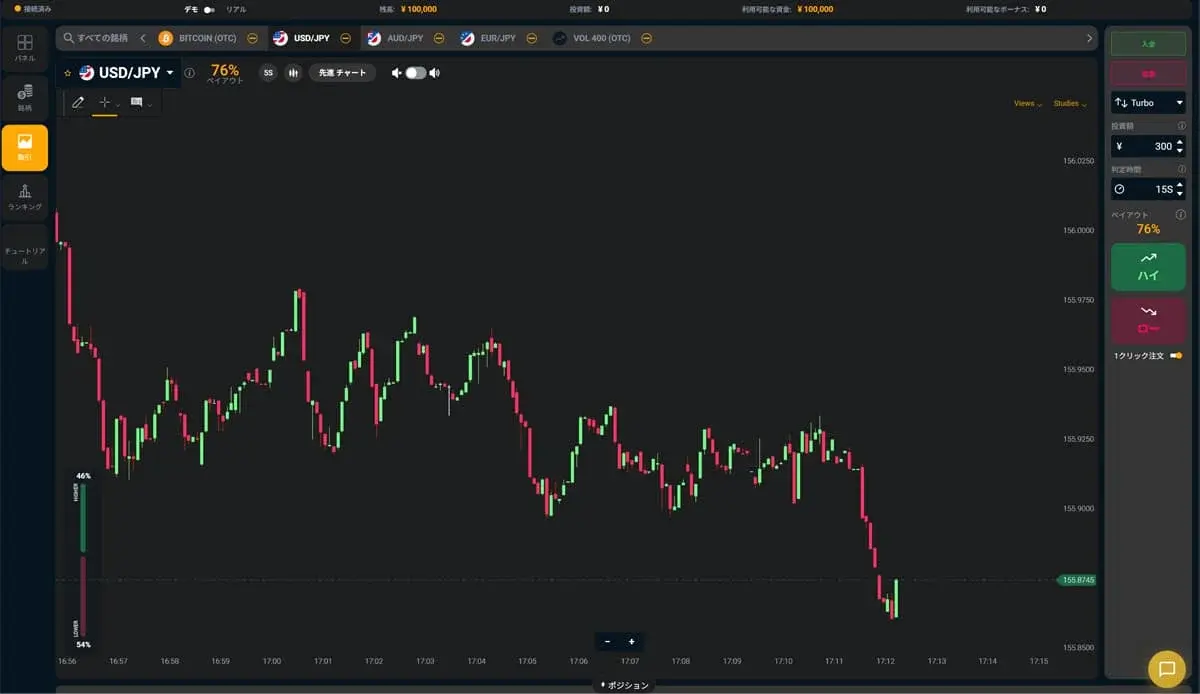
Experience the Bi-Winning trading platform risk-free
Try the Bi-Winning trading platform for free right now. No registration required to try High/Low trading. Your demo account comes with 100,000 JPY in virtual funds.
Try a free demo now
Experience the real trading environment without using real money
Company Information
Providing a safe, secure, and comfortable trading environment for all investors.
| Company | Alpha Options LLC |
| Location | Euro House, Richmond Hill Road, Kingstown, St. Vincent and the Grenadines |
| Support Hours | 10:00 – 17:00 (JST)Excluding weekends, holidays, and year-end closures |
| Business Succession | Succeeded from BET GLOBAL MARKET INC. on February 7, 2025 |
| Contact | Contact Us |
| Official Twitter | https://x.com/BIWINNING1 |
関連記事

バイナリーオプションの移動平均線の使い方|期間設定とパーフェクトオーダー
バイナリーオプションで移動平均線を使うとき、期間の選び方とパーフェクトオーダーの判断で迷う方は多いです。MT5で選べる4種類の計算方式の違い、判定時間ごとのおすすめ期間、2本のゴールデンクロスと3本のパーフェクトオーダーの使い分け、ダマシを避ける確認ポイントまで解説します。

バイナリーオプションのボリンジャーバンド攻略|逆張りと順張りの使い分け
バイナリーオプションでボリンジャーバンドを使うとき、バンドタッチだけで逆張りすると読みが外れやすくなります。帯の幅とタッチの本数、ミドルバンドの傾きという3つの見た目から、レンジ相場の逆張りとトレンド相場の順張りを使い分ける判断基準を解説します。

オンランプでの暗号通貨購入の方法|クレカでUSDTを買って入金する手順
オンランプでの暗号通貨購入の方法を解説します。日本のクレジットカードでUSDTを購入する6ステップ、口座開設が不要な入手ルート、購入できる金額の範囲、そのままBi-Winningへ入金する手順、入金額が少し足りないときの買い足し方までまとめました。