Overseas Forex Leverage Calculation Methods Explained! How to Calculate Required Margin and Rules for Risk Management

"Leverage" is one of the biggest attractions of Overseas Forex. This mechanism that enables large trades with small capital is a powerful tool for efficiently pursuing profits. However, many people may have questions or concerns such as these. Calcu...
Try a free demo now
Experience the real trading environment without using real money
"Leverage" is one of the biggest attractions of Overseas Forex.
This mechanism that enables large trades with small capital is a powerful tool for efficiently pursuing profits.
However, many people may have questions or concerns such as these.
- The calculation method is complex and hard to understand
- I can't determine what level of leverage is appropriate
In this article, we will explain everything from the basic concepts of leverage in Overseas Forex, to the calculation methods for "required margin" which is essential for trading, and specific risk management techniques for safely utilizing leverage, all in a way that even beginners can easily understand.
What Is Overseas Forex Leverage? Understanding the Mechanism
"High leverage" is often cited as a major attraction of Overseas Forex, but what exactly is leverage? While it is known as a mechanism that allows large trades with small capital, starting to trade without properly understanding its specific mechanics and risks is dangerous.
[What You'll Learn in This Chapter]
- Leverage is a mechanism that allows you to trade amounts many times larger than your deposited funds (margin)
- Due to Japan's Financial Services Agency regulations, the maximum leverage for domestic FX is limited to 25x
- In Overseas Forex, the "zero-cut system" with no margin calls eliminates the risk of losses exceeding your margin
Leverage Basics
Leverage means "the principle of the lever" in Japanese.
In FX trading, it refers to a mechanism that allows you to conduct trades many times larger than the funds (margin) deposited in your account.
For example, if you select a leverage of 100x and deposit 100,000 yen as margin, you can trade up to 10,000,000 yen worth of currency (100,000 yen x 100x). This creates opportunities to earn large profits that would be impossible with your own capital alone.
Differences Between Domestic and Overseas Forex Leverage
When it comes to leverage, there is a critical difference between domestic and Overseas Forex. That is the presence or absence of regulations on leverage limits.
Japan's Financial Services Agency, from the perspective of investor protection, strictly limits the maximum leverage for individual domestic FX trading to 25x.

Source: Key Rules for Investor Protection
On the other hand, many Overseas Forex brokers operate outside the direct jurisdiction of Japan's financial regulations, and some offer very high leverage of 500x, 1,000x, or even unlimited.
Item | Domestic FX | Overseas Forex |
|---|---|---|
Maximum Leverage | 25x | Hundreds to unlimited |
Margin Calls | Yes | No (Zero-Cut System) |
Regulatory Authority | Financial Services Agency | Financial licensing authorities of each country |
This high leverage is arguably the biggest attraction of Overseas Forex that draws many traders.
Advantages and Disadvantages of Leverage
Leverage has both benefits and points to be cautious about.
[Advantage] Capital Efficiency
The greatest advantage of leverage is the ability to make large trades with small capital. Even small price movements can lead to large profits.
[Disadvantage] Risk of Amplified Losses
However, just as profits are amplified, losses are also amplified in the same way.If the market moves in the opposite direction of your prediction, high leverage can cause you to incur large losses very quickly.
The most important thing when dealing with leverage is understanding the risks and controlling them properly. Recognizing both the advantages and disadvantages and managing them carefully is the key to success.
Leverage Calculation Basics! Understanding the Required Margin for Trading
The next thing you need to know is the specific calculation method for "how much capital is needed for actual trading." Even if you can utilize high leverage, failing to accurately understand the required margin and risks could lead to unexpected losses.
[What You'll Learn in This Chapter]
- The effective leverage applied to your trades can be calculated with a simple formula
- "Required margin" is the minimum amount of funds needed to hold a specific position
- Understanding "lots" (trading volume units) and "pips" (price movement units) is essential for accurate risk management
Effective Leverage Formula and Examples
Let's understand how much leverage is actually being applied to the positions you currently hold (this is called "effective leverage").
Effective leverage can be calculated using the following formula.
Effective Leverage = (Exchange Rate x Trade Volume) / Equity
Equity is your account balance plus the unrealized profit or loss of your open positions.
For example, suppose you have 100,000 yen in your account, hold a long position of 10,000 USD when the rate is 150 yen per dollar, and currently have 10,000 yen in unrealized gains.
In this case, the equity is 110,000 yen (100,000 yen + 10,000 yen).
Effective Leverage = (150 yen x 10,000 units) / 110,000 yen ≈ 13.6x
This is the result.
Required Margin Formula and Examples
Before starting to trade, you must understand "required margin". It refers to the minimum amount of funds that must be deposited in your account to open a specific position in a specific currency pair.
[Formula]
Required Margin = (Exchange Rate x Trade Volume) / Maximum Leverage
[Example]
Let's consider the case of trading 10,000 units (0.1 lot) when the rate is 150 yen per dollar with an account that has a maximum leverage of 1,000x.
Required Margin = (150 yen x 10,000 units) / 1,000x = 1,500 yen
In other words, a minimum of 1,500 yen is required in your account for this trade.
By understanding this formula, you can plan in advance how large a trade is possible with your available capital. It is important to perform this calculation before trading and determine a manageable trade size.
Basics of Lots and Pips
When looking at an FX trading platform, you'll frequently encounter terms like "lot" and "pips." These are important units that form the basis for leverage and profit/loss calculations.
Lot
- A unit of trading volume in FX
- At most Overseas Forex brokers, 1 lot is defined as 100,000 units of currency
- This means that a 1-lot USD/JPY trade involves buying or selling 100,000 US dollars
Pips
- Short for "percentage in point," it represents the smallest unit of exchange rate movement
- For most currency pairs, the 4th decimal place (0.0001) counts as 1 pip
- However, for currency pairs involving the Japanese yen (USD/JPY, EUR/JPY, etc.), the 2nd decimal place (0.01 yen = 1 sen) is generally counted as 1 pip
Getting familiar with these units is key to conducting FX trading smoothly.
Tips for Safely Utilizing High Leverage in Overseas Forex
While high leverage is an attraction of Overseas Forex, many people may feel anxious, wondering "Isn't there a big risk?" or "Is there a way to use it safely?" In fact, Overseas Forex has a unique protective feature called the "zero-cut system," and with proper risk management, even beginners can trade safely.
[What You'll Learn in This Chapter]
- The "zero-cut system" is a safety net unique to Overseas Forex that prevents losses exceeding your deposit amount
- Keeping your margin maintenance rate high is key to avoiding forced liquidation
- Practicing on a demo account and consistently setting stop-losses leads to safe trading
What Is the Zero-Cut System? Peace of Mind with No Margin Calls
One of the greatest advantages of Overseas Forex is the "zero-cut system". Even if a sudden market movement causes your account balance to go negative because the stop-loss couldn't execute in time, the FX broker absorbs the negative amount and resets your account balance to zero.
In domestic FX, in such cases, "margin calls (additional margin requirements)" occur, and investors face the risk of losses exceeding their principal.
The Financial Services Agency also mentions the possibility of margin calls as a risk of foreign exchange margin trading.

Source: Financial Services Agency: What Is "Foreign Exchange Margin Trading"
With the zero-cut system in Overseas Forex, losses are limited to the deposited amount even in the worst-case scenario, so traders can approach trading with peace of mind.
Stop-Out and Margin Maintenance Rate
If the zero-cut system is the last line of defense, the safety net in front of it is "stop-out (forced liquidation)".
A stop-out is a mechanism where positions are forcibly closed to prevent further losses when the unrealized loss on open positions expands and the margin maintenance rate falls below a certain level set by the FX broker.
The margin maintenance rate is calculated using the following formula.
Margin Maintenance Rate (%) = (Equity / Required Margin) x 100
Keeping this rate consistently high, meaning not holding excessive positions relative to your account funds, is the basic strategy for avoiding stop-outs. Generally, when the margin maintenance rate approaches the broker's stop-out level (e.g., 20%-50%), it is considered a danger zone; above 500% is considered relatively safe.
Risk Management for Beginners to Avoid Failing with High Leverage
High leverage has a dual nature of amplifying both profits and losses. To maximize its benefits while minimizing risks, thorough risk management is essential.
Risk Management Measure | Specific Actions |
|---|---|
Use Demo Accounts | First, experience trading with virtual funds to become familiar with the feel of leverage and how to operate the tools |
Practice with Small Amounts | Rather than investing large capital from the start, begin with the minimum trade size using only surplus funds that won't affect your daily life if lost |
Always Set Stop-Losses | Make it a habit to always place a stop-loss order, deciding "if the price falls to this level, I will close the position," at the same time you open a position |
Personal Money Management Rules | Set the maximum allowable loss per trade to within 2% of your total capital, and strictly adhere to this rule |
Not neglecting diligent management will be the key to surviving in the market over the long term.
Summary
High leverage has a dual nature of amplifying both profits and losses. To maximize its benefits while minimizing risks, thorough risk management is crucial.
Always be mindful of "effective leverage" and "margin maintenance rate," and trade with appropriate position sizes that match your capital. Also, rather than relying on the "zero-cut system," which is a safety net unique to Overseas Forex, it is important to take a proactive approach to managing risk by consistently setting stop-losses.
Start by practicing thoroughly on a demo account and begin with small trades to develop a solid feel for leverage and pursue safe, smart trading.
Additionally, choosing a trading style like Binary Options, where profits and losses are predetermined, is another option. Among them, "Bi-Winning" offers an intuitive interface and mobile compatibility, making it an easy environment for beginners to get started.
"Bi-Winning" offers a free demo experience with no registration required. Why not try the actual trading experience?
Experience the Bi-Winning trading platform risk-free
Try the Bi-Winning trading platform for free right now. No registration required to try High/Low trading. Your demo account comes with 100,000 JPY in virtual funds.
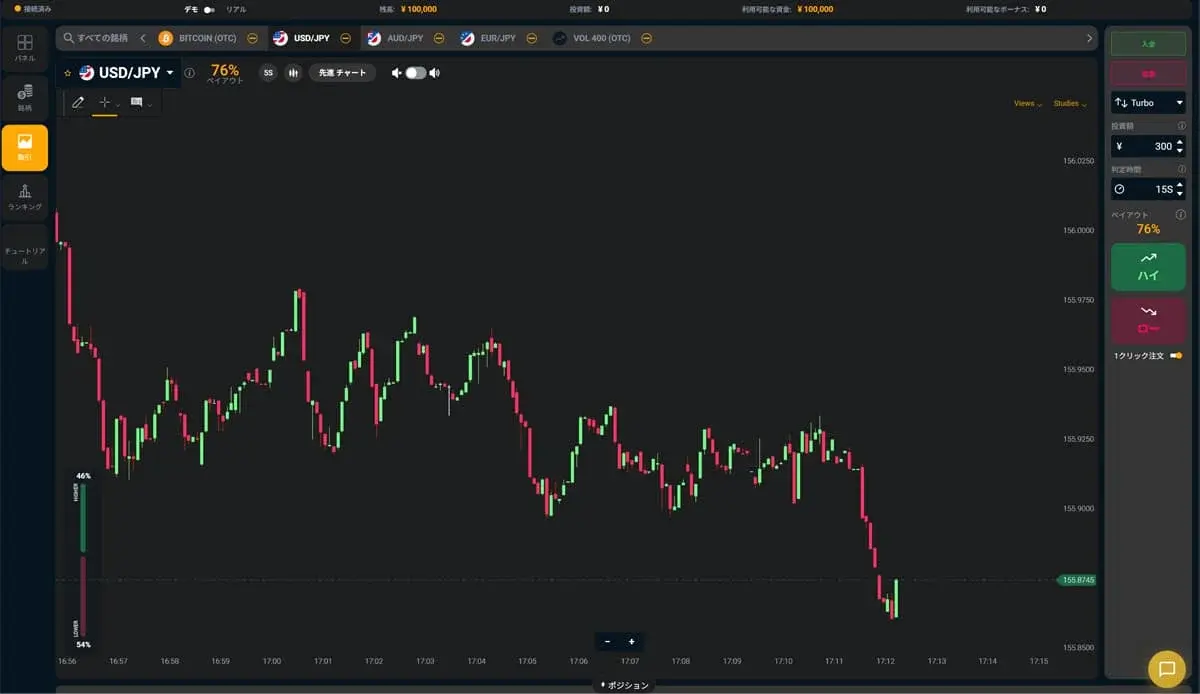
Try a free demo now
Experience the real trading environment without using real money
Company Information
Providing a safe, secure, and comfortable trading environment for all investors.
| Company | Alpha Options LLC |
| Location | Euro House, Richmond Hill Road, Kingstown, St. Vincent and the Grenadines |
| Support Hours | 10:00 – 17:00 (JST)Excluding weekends, holidays, and year-end closures |
| Business Succession | Succeeded from BET GLOBAL MARKET INC. on February 7, 2025 |
| Contact | Contact Us |
| Official Twitter | https://x.com/BIWINNING1 |
関連記事
ハイロー取引のデモはどこでできる?登録不要で試せる無料デモの始め方
ハイローのデモは今も試せるのか、登録やメールアドレスは必要なのかを解説します。以前使えたデモが終了するまでの流れと、登録不要で試せる無料デモの条件、仮想資金がなくなったときの扱い、始め方の手順までまとめました。デモで確認しておきたいポイントもあわせて紹介します。
ハイローオーストラリアの代わりは?終了後の乗り換え先を比較【2026年】
ハイローオーストラリアは2025年6月30日に終了しました。代わりを探している方に向けて、乗り換え先の候補を最低入金額・最低取引額・ペイアウト・出金条件で比較し、公式の後継サービスの考え方と業者選びのポイントを解説します。
バイナリーオプションの移動平均線の使い方|期間設定とパーフェクトオーダー
バイナリーオプションで移動平均線を使うとき、期間の選び方とパーフェクトオーダーの判断で迷う方は多いです。MT5で選べる4種類の計算方式の違い、判定時間ごとのおすすめ期間、2本のゴールデンクロスと3本のパーフェクトオーダーの使い分け、ダマシを避ける確認ポイントまで解説します。