High/Low Trading: A Complete Guide to How It Works, the Process, and Its Pros & Cons
You may have heard the term "High/Low trading," but many people still have questions like: How does High/Low trading work? I don't understand the money flow or trading process. I want to know the pros and cons in detail...
Try a free demo now
Experience the real trading environment without using real money
You may have heard the term "High/Low trading," but many people still have questions like the following:
- How does High/Low trading work?
- I don't understand the money flow or trading process
- I want to know the pros and cons in detail
This article covers everything from how High/Low trading works, the actual trading process, its pros and cons, to tips for avoiding common mistakes.
Understanding the Money Flow and Timeline of High/Low Trading
Before starting High/Low trading, it's important to understand the big picture of how money moves and how trades progress. Starting without understanding the mechanism can lead to unexpected losses.
What You'll Learn in This Section
- The money flow in High/Low trading: "Investment -> Judgment -> Profit/Loss Confirmed"
- The specific timeline from trade start to result confirmation
- How payout (refund) works and how to calculate profit/loss
How Does the Money Flow in High/Low Trading?
Let's look at how money flows in High/Low trading.
Step 1: Decide the Investment Amount and Purchase
First, select the asset you want to trade (such as a currency pair), and predict whether the price will go "up (High)" or "down (Low)." Then, decide your investment amount and press the purchase button.At this point, the investment amount is deducted from your account.
Step 2: Wait Until the Judgment Time
After purchasing, wait until the predetermined judgment time (expiry). The judgment time varies by trade, ranging from a few minutes to several hours.
Step 3: Results Are Confirmed at Judgment Time
When the judgment time arrives, results are automatically confirmed.
- If your prediction is correct
You receive a payout of investment amount x payout rate - If your prediction is wrong
The investment amount is not returned (loss confirmed)
Calculating High/Low Trading Profits with a Real Example
Let's look at the profit and loss of High/Low trading using actual numbers.
Example: Investing 1,000 yen at a payout rate of 1.85x
Prediction Result | Payout Amount | Profit/Loss |
|---|---|---|
Prediction correct | 1,850 yen | +850 yen profit |
Prediction wrong | 0 yen | -1,000 yen loss |
With binary options, "how much you earn" and "how much you lose" are determined at the time of purchase.Profit is the payout amount minus the purchase price, and the maximum loss is limited to the purchase price. This is a major difference from FX and stock trading.
Timeline from Trade Start to Result Confirmation
Here's a chronological overview of the High/Low trading process:
Trading Timeline
Time Elapsed | Action | Key Point |
|---|---|---|
0 min | Select asset and direction | Choose from 100+ options including forex, stock indices, and cryptocurrencies |
0 min | Decide investment amount | Can be set from as low as around 500 yen |
0 min | Press the purchase button | Investment amount is confirmed at this point |
1-5 min later | Judgment time arrives | Short-term trades produce results in minutes |
Judgment time | Result confirmed / Payout | Correct prediction = payout, wrong = loss |
The entire process from trade start to result confirmation can be completed in just minutes, allowing even busy people to trade in their spare time — that's the hallmark of High/Low trading.
What Is High/Low Trading? Understanding the Basics
Now that you have an overview of High/Low trading, let's dive deeper into the fundamental question of what it actually is.
What You'll Learn in This Section
- Definition and mechanism of High/Low trading (Binary Options)
- Specific differences from FX trading
- Types of tradable assets
High/Low Trading = The Basics of Binary Options
High/Low trading is a type of financial product called Binary Options. As the name suggests — combining "binary" (two choices) and "option" (the right to choose) — it involves predicting whether a price will go up or down.
The basic rules are as follows:
Basic Rules of High/Low Trading
- If you predict the price will be "higher" at judgment time, select "High"
- If you predict the price will be "lower" at judgment time, select "Low"
- Correct prediction = payout; wrong prediction = investment amount lost
The rules are extremely simple, making them easy for investment beginners to understand and get started without complex financial knowledge.
Differences Between High/Low Trading and FX Trading
Even though both deal with currencies, there are clear differences between High/Low trading and FX trading.
Comparison | High/Low Trading | FX Trading |
|---|---|---|
How profit/loss is determined | Determined by prediction accuracy | Varies based on price movement |
Maximum loss | Limited to investment amount (predetermined) | Can exceed investment due to leverage |
Settlement timing | Automatic at judgment time | You choose when to settle |
Leverage | None | Up to 25x (domestic) |
Unrealized losses / Holding positions | Does not occur | Can occur |
In FX, profit/loss changes depending on the magnitude of price movement, but in High/Low trading, it's simply "right or wrong." Even a small price movement results in profit as long as your prediction is correct.
Tradable Assets in High/Low Trading
In High/Low trading, you can trade various assets beyond just currencies.
Asset | Examples |
|---|---|
Currency Pairs | USD/JPY, EUR/JPY, GBP/JPY, etc. |
Stock Indices | Nikkei 225, Dow Jones, etc. |
Commodities | Gold, Crude Oil, etc. |
Cryptocurrencies | Bitcoin, Ethereum, etc. |
Some trading platforms offer over 100 types of assets, allowing you to trade in areas you're familiar with or markets that interest you.
Pros and Cons of High/Low Trading: A Detailed Analysis
High/Low trading has unique advantages that other investment methods don't offer, but it also has its drawbacks. Let's understand both pros and cons before getting started.
What You'll Learn in This Section
- 5 advantages of High/Low trading (low starting amount, limited losses, etc.)
- 4 disadvantages to be aware of (full loss on wrong prediction, etc.)
- Smart trading strategies based on understanding the pros and cons
5 Advantages of High/Low Trading
Advantage 1: Start with Small Amounts
High/Low trading allows you to trade from as little as around 500 yen.Stock or FX trading often requires tens of thousands of yen to start, but High/Low trading lets you begin with a "let me try" mindset, making it easy to get started.
Advantage 2: Maximum Loss Is Predetermined
The maximum loss is limited to the investment amount — this is a major feature of High/Low trading. Unlike FX where unexpected losses can occur through leverage, you know "how much you can lose" from the start, making capital management easier.
Advantage 3: Simple Rules That Are Easy to Understand
You simply predict "up or down" — no complex financial knowledge required. It's suitable as an introduction for beginners to learn about currency movements.
Advantage 4: Quick Results
Results come in minutes to hours after the trade starts, so you don't have to worry about "when to settle" like in FX. There are no stagnant positions, and you can always approach the next trade with a clear mind.
Advantage 5: Profit Possible Even with Small Price Movements
In FX, small price movements mean small profits, but in High/Low trading, you receive the same payout as long as your prediction is correct.Being able to profit even in range-bound markets with little price movement is an attractive feature.
4 Disadvantages of High/Low Trading
Disadvantage 1: You Lose the Entire Investment on a Wrong Prediction
In High/Low trading, a wrong prediction means your entire investment becomes a loss.Even a "close call" results in the same loss amount, so consecutive wrong predictions can quickly deplete your funds.
Disadvantage 2: Large Short-Term Profits Are Difficult
Since the payout amount is fixed, unlike FX where you can "hit it big when the market moves significantly." It's suited for a style of steadily accumulating profits rather than hitting the jackpot.
Disadvantage 3: Emotional Trading Is a Risk
Because of its simple rules, it's easy to fall into baseless "gut feeling" trades. Also, after a loss, the urge to "win it back" can lead to clouded judgment. Mental control is essential to avoid gambling-like trading.
Disadvantage 4: Not Suitable for Long-Term Investing
With judgment times ranging from minutes to hours, long-term strategies like FX swing trading cannot be applied. The ability to read short-term price movements is required.
Smart Trading Methods Based on Understanding Pros and Cons
High/Low trading has the advantage of "starting small with limited losses," but also carries the risk of "losing the entire amount on a wrong prediction."
Advantages | Disadvantages |
|---|---|
Start from as little as 500 yen | Lose entire investment on wrong prediction |
Maximum loss predetermined | Difficult to earn large short-term profits |
Simple rules, beginner-friendly | Prone to emotional trading |
Quick results | Not suitable for long-term investing |
Profit possible even with small price movements | — |
Consider both the pros and cons to determine whether High/Low trading is right for you.
Tips to Avoid Failure in High/Low Trading
To consistently profit from High/Low trading, there are several key points to keep in mind. Beginners should especially focus on the following:
What You'll Learn in This Section
- How to develop practical skills using a demo account
- The importance of starting small and building experience
- How to create personal "trading rules" to avoid emotional decisions
Practice with a Demo Account Before Going Live
Before starting High/Low trading, practice with a demo account (trial account). Demo accounts let you experience trading without using real money.
- Get familiar with the trading platform interface
- Learn how to read charts
- Test your prediction accuracy
Since you can develop practical skills with zero risk, beginners should always start with a demo account. Transitioning to real trading after sufficient practice will help prevent unnecessary losses.
Start Small and Gradually Build Experience
Once you've gained confidence with the demo account, it's time for real trading. However, avoid investing large amounts from the start.
Reasons to Start Small
- Your mental state changes when real money is involved
- Results in real trading can differ from demo performance
- You can gain experience within a range that won't affect your daily life
Start with an amount you'd consider "an acceptable tuition fee for learning," and gradually increase your investment as you gain experience.
Create Your Own "Trading Rules"
Many people who fail at High/Low trading do so because they let emotions take over. To prevent this, establish your own set of trading rules in advance.
Examples of Trading Rules
Rule Category | Example |
|---|---|
Daily trade limit | Set a maximum of "5 trades per day" |
Daily loss limit | Stop trading after losing "2,000 yen per day" |
Investment per trade | Keep within "5% of total funds" |
Trading hours | Limit to "active market hours only" |
Once you've set your rules, it's crucial to follow them strictly. Especially after consecutive losses when composure is most likely to slip, "that's enough for today" — have the courage to stop decisively when you've reached your limit.
Make Predictions Based on Evidence
High/Low trading has a simple structure, but relying solely on "gut feeling" won't sustain long-term profitability.
To improve your win rate, learn basic analytical skills like the following:
- Check chart trends (upward or downward tendencies)
- Keep track of economic indicator release schedules
- Review past trades to analyze winning and losing patterns
Perfect predictions are impossible, but "why am I betting in this direction?" — if you trade with this kind of reasoning, you'll reduce emotional decisions and improve your win rate.
Conclusion
High/Low trading is a simple form of investing where you predict whether prices will go "up or down." While it offers the convenience of starting with small amounts, a wrong prediction means losing the entire investment, so practicing with a demo account and establishing your own trading rules are essential.
Trade without letting emotions take over, and always have evidence backing your decisions. If you're ready to start with binary options, Bi-Winning is worth checking out.
Experience the Bi-Winning trading platform risk-free
Try the Bi-Winning trading platform for free right now. No registration required to try High/Low trading. Your demo account comes with 100,000 JPY in virtual funds.
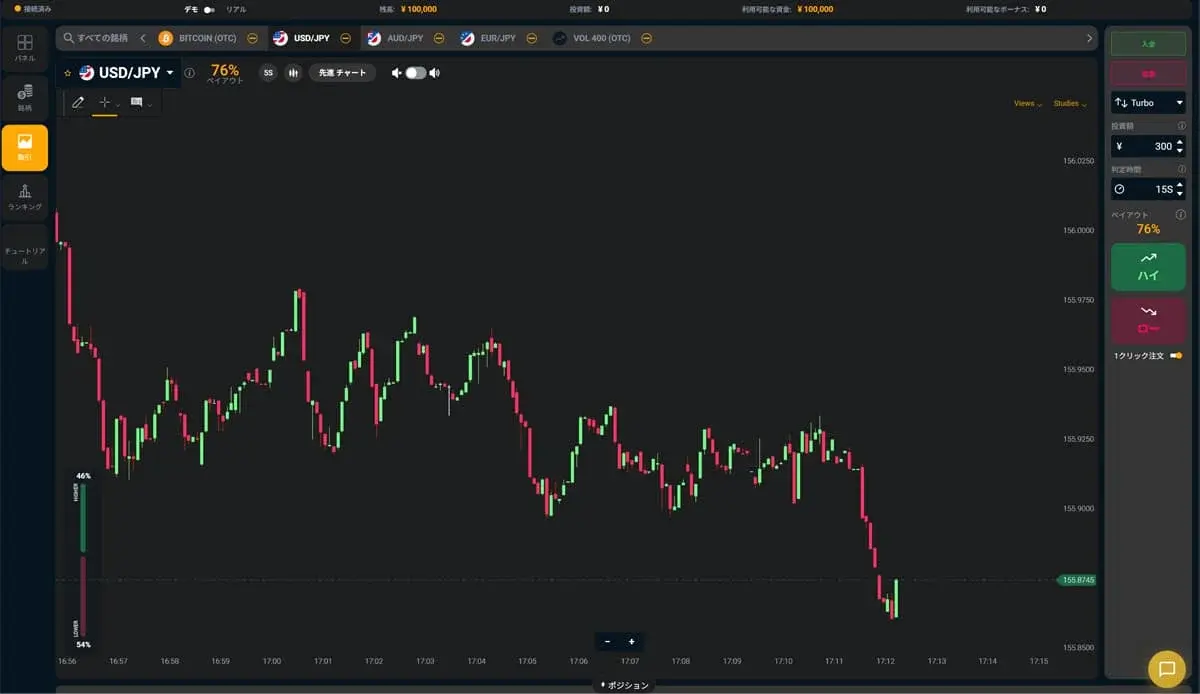
Try a free demo now
Experience the real trading environment without using real money
Company Information
Providing a safe, secure, and comfortable trading environment for all investors.
| Company | Alpha Options LLC |
| Location | Euro House, Richmond Hill Road, Kingstown, St. Vincent and the Grenadines |
| Support Hours | 10:00 – 17:00 (JST)Excluding weekends, holidays, and year-end closures |
| Business Succession | Succeeded from BET GLOBAL MARKET INC. on February 7, 2025 |
| Contact | Contact Us |
| Official Twitter | https://x.com/BIWINNING1 |
関連記事

ハイロー取引のデモはどこでできる?登録不要で試せる無料デモの始め方
ハイローのデモは今も試せるのか、登録やメールアドレスは必要なのかを解説します。以前使えたデモが終了するまでの流れと、登録不要で試せる無料デモの条件、仮想資金がなくなったときの扱い、始め方の手順までまとめました。デモで確認しておきたいポイントもあわせて紹介します。

ハイローオーストラリアの代わりは?終了後の乗り換え先を比較【2026年】
ハイローオーストラリアは2025年6月30日に終了しました。代わりを探している方に向けて、乗り換え先の候補を最低入金額・最低取引額・ペイアウト・出金条件で比較し、公式の後継サービスの考え方と業者選びのポイントを解説します。

Can You Really Not Win at High/Low Trading? The Truth Behind the 'You Should Quit' Claims
Are you feeling anxious after seeing claims that 'you can't win at High/Low trading' or 'you should quit'?... Can You Really Not Win at High/Low Trading?