Trend Following and Contrarian Trading in Binary Options | The Complete Guide to Choosing by Market Condition

A guide to switching between trend following and contrarian trading in binary options based on market condition, time of day, and expiry time, with a quick-reference table and step-by-step process. Helps beginners choose a strategy on the spot.
Try a free demo now
Experience the real trading environment without using real money
Trend following or contrarian trading — which one should you actually use? This is the very first question that trips up people who are new to binary options. The short answer: there's no single correct choice. The method you should use is decided automatically by whether the current market is trending or ranging, what time of day it is, and how long an expiry time you can take. This article organizes the decision process — so you can choose trend following or contrarian trading on the spot — along with a quick-reference table.
The Basic Difference Between Trend Following and Contrarian Trading

Trend following and contrarian trading are opposite approaches in terms of which market move they ride.
The Idea Behind Trend Following
Trend following means entering in the same direction as the current flow. If the price is in an uptrend, you choose Up; if it's in a downtrend, you choose Down. Because you simply ride the trend's continuing momentum, you rarely hesitate about entry direction as long as you can read which way the price is moving — which makes it the method beginners should learn first.
The Idea Behind Contrarian Trading
Contrarian trading aims to catch the moment when an overextended price move reverses. You choose Down where the price has risen too far, and Up where it has fallen too far. While it offers more entry opportunities, it requires judging when a bounce is "about due," a step up in difficulty from trend following.
The Premise: Ranging Markets Last Longer
The market isn't always trending. In reality, the time spent in a ranging market — where the price moves back and forth within a fixed band — is longer than the time spent in a clearly trending market.
That's exactly why learning only trend following, or only contrarian trading, limits your trading opportunities. Only once you can switch between contrarian trading in ranges and trend following in trends, matching the method to the market, do your trading opportunities steadily increase.
Quick-Reference Table: Choosing by Market Condition and Time of Day
Choosing between trend following and contrarian trading isn't a matter of feel — it can be judged by conditions. Putting market condition, time of day, expiry time, and the indicators to watch into a single table gives you the following.
Market Condition | Time Zone It Tends to Appear (Japan Time) | Suitable Strategy | Guideline for Expiry Time | Main Indicators to Watch |
|---|---|---|---|---|
Range (price stays within a band) | Around 8:00–17:00 Tokyo time (watch for a brief move around the 9:55 TTM fixing) | Contrarian trading (Down at the top, Up at the bottom) | Shorter (roughly 1–5 minutes) | Bollinger Bands, RSI, support and resistance lines |
Trend (higher highs/higher lows, or lower highs/lower lows) | London–New York session, around 21:00–2:00 JST is most active | Trend following (same direction as the flow) | Somewhat longer (roughly 10 minutes or more) | Moving averages, MACD, highs/lows per Dow Theory |
Turning point (breakout from a range) | Any time of day, around economic indicator releases or statements from key officials | Stand aside, or trend-follow in the direction of the breakout | Depends on the situation | Line breakout, momentum of the candlestick |
This table lets you compare, all at once, the "market condition," "time of day," and "expiry time" that most articles cover separately. In particular, the expiry time column solves the very binary-options-specific worry of "so how many minutes should I actually set?" That said, the relationship between time of day and market condition is only a tendency, and there are exceptions — use it as an initial guideline.
Why Contrarian Trading Tends to Work in Ranging Markets, and When
In a ranging market, the price moves back and forth between a fixed upper and lower boundary. Because it tends to fall as it nears the top and rise as it nears the bottom, this fits well with contrarian trading, which aims to catch reversals. Tokyo time — Japan's morning through evening — tends to see relatively small price moves and is prone to ranging. That said, brief moves can occur around the 9:55 TTM fixing announcement, so it's safer to watch and wait just before and after that time.
Why Trend Following Tends to Work in Trending Markets, and When
In a trending market, highs and lows keep rising, or keep falling, in one direction. Trend following, which can ride the momentum of a continuing flow, has the advantage here. From the evening onward, when the London market opens, and especially from 21:00 to around 2:00 the next day when it overlaps with the New York market, trading is most active for the day and trends tend to appear. If you're trading at night, centering your approach on trend following fits the market well.
Three Things to Check Before Entering
Once you have the quick-reference table in mind, checking the following three points in order — right before you actually enter — determines which method you should use right now.
Check 1: Is It a Trend or a Range?
First, look at the chart to see whether the price keeps making higher highs/lows (or lower highs/lows), or whether it's moving back and forth within a fixed range. If there's a clear direction, trend following is the basic candidate; if it's moving back and forth, contrarian trading is.
Check 2: What's the Current Time of Day?
Next, check the time of day. During Tokyo time, the market tends to lean toward ranging, where contrarian trading tends to work; during the London–New York session, it tends to lean toward trending, where trend following tends to work. If the time-of-day tendency matches your judgment from Check 1, your confidence in that method increases.
Check 3: How Long an Expiry Time Should You Set?
Finally, decide the expiry time. Because a reversal in contrarian trading tends not to last long, a shorter expiry suits it better; because trend following rides the flow, taking a somewhat longer expiry makes it easier to capture that flow. On Bi-Winning, you can choose expiry times in 1-minute increments from 1 to 5 minutes, and in 5-minute increments from 10 minutes onward (there is no setting for 6–9 minutes). There's also a 23-hour trade that settles daily at 23:00, giving you an environment you can adjust to fit your strategy. For example, if the price is approaching the top of a range around 14:00 Tokyo time and the RSI is above 70, that's a scene where you'd consider a shorter expiry time and a contrarian Down trade.
Stop Contrarian Trading Once the Range Breaks Out
The thing to watch out for most when aiming for a contrarian trade is a "breakout" — a forceful move through the top or bottom of the range. The moment it breaks out is often the start of a new trend, making it the scene where contrarian trading is most likely to miss. If the price breaks through the top or bottom with a strong candlestick, stop contrarian trading immediately. It's safer to either switch to trend following in the direction of the breakout, or stand aside if you're unsure. Breakouts tend to happen around economic indicator releases or statements from key officials, so watch those times with extra caution.
Indicators to Use for Trend Following and Contrarian Trading
Once you've decided on a method, pair it with supporting indicators. Because the two methods have different goals, the indicators worth watching differ too.
For trend following, moving averages and MACD are the basics. A moving average shows the average direction of the price — if the line is sloping up, that's a rise; if it's sloping down, that's a fall, letting you judge the flow. This way of catching the flow through higher highs/lows or lower highs/lows overlaps with the Dow Theory mentioned in the quick-reference table. A golden cross, where the short-term line crosses above the long-term line, is a signal of a rise; a dead cross, where it crosses below, is a signal of a fall — both are clear cues for a trend-following entry. Use MACD as a supporting tool to confirm the flow's momentum and turning points.
For contrarian trading, Bollinger Bands and RSI are the standards. Bollinger Bands show the price's range of movement as a band, and when the price reaches the upper or lower edge of the band, that's a guideline for aiming at a bounce. RSI shows overbought or oversold conditions as a number, generally judged as overbought at 70 or above and oversold at 30 or below. Combining it with support and resistance lines makes the case for a bounce clearer.
Check out this article on how to use RSI!
→How to Use RSI in Binary Options: Settings and Avoiding False Signals
Situations Where Trend Following and Contrarian Trading Tend to Lose, and How to Handle Them
Both methods have typical situations where they tend to miss. Knowing them in advance lets you avoid them.
With trend following, the situation most prone to losses is jumping in near the end of a trend. If you rush to ride the same direction after a big move has already happened, you're more likely to catch the exact moment the momentum runs out and reverses. The fix is to get in at an early stage after the flow has started, and to wait for a pullback (a temporary dip during a rise) or a rally (a temporary bounce during a fall) before entering.
With contrarian trading, the situation most prone to losses is going against the breakout described above. A typical case is assuming it's a range and aiming for a bounce, only to have the price break through the band or line and start running. The fix is to stop contrarian trading once the price breaks out forcefully, and to avoid trading around the time of indicator releases.
Frequently Asked Questions
Q1. Should beginners start with trend following or contrarian trading?
We recommend starting with trend following. Because you simply ride the direction the trend is already moving in, it's an easy way to practice reading which way the price is heading. Contrarian trading requires judging the timing of a bounce, so it's less likely to trip you up if you take it on after getting used to trend following.
Q2. I thought it was a range and traded contrarian, but the price broke out and I lost. How can I prevent that?
Once the price breaks through the top or bottom of the range with a strong candlestick, stop the contrarian trade. The moment it breaks out is often the start of a new trend, making it the scene where contrarian trading is most likely to miss. Breakouts tend to happen right before and after economic indicator releases or statements from key officials, so holding off on entries during those times is also effective.
Q3. How should I change the expiry time between trend following and contrarian trading?
Because a reversal in contrarian trading tends not to last long, a shorter expiry time suits it better. Because trend following rides the flow, taking a somewhat longer expiry than contrarian trading makes it easier to capture that flow. Bi-Winning lets you fine-tune the expiry time, so adjust it to fit your strategy.
Q4. Is it okay to switch between trend following and contrarian trading within the same day?
That's fine — in fact, it's ideal. The approach of leaning toward contrarian trading during the range-prone morning-to-evening hours in Japan time, and toward trend following during the trend-prone London–New York session at night, matches how the market actually tends to move.
Q5. What should I do when the trend-following signal and the contrarian signal point in opposite directions?
Prioritize whichever fits the current market condition. If a trend is clearly showing, go with the trend-following signal; if it's clearly ranging, go with the contrarian signal. If you're torn and can't feel confident, it's wiser to stand aside rather than force an entry.
Summary
Neither trend following nor contrarian trading is inherently superior. Trend-follow when a trend is showing, trade contrarian when it's ranging, decide your method by checking it against the market condition and time of day, and match your expiry time to it. Master this process, and you'll be able to enter without hesitation.
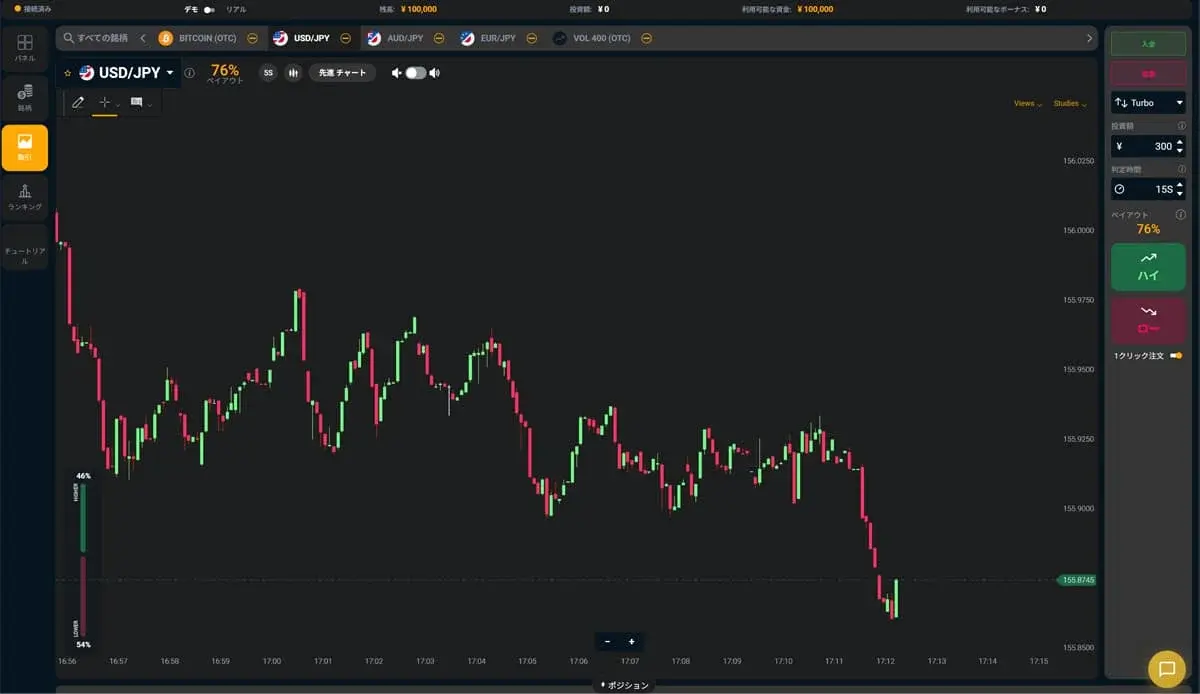
That said, in actual trading you may find it hard to think calmly. We recommend starting with trend following in a risk-free demo account, then gradually practicing contrarian trading once you're comfortable. With Bi-Winning's demo trading, you can try out the three checks from this article exactly as described, while freely changing the expiry time. See for yourself, on a real chart, whether today's market favors trend following or contrarian trading.
Experience the Bi-Winning trading platform risk-free
Try the Bi-Winning trading platform for free right now. No registration required to try High/Low trading. Your demo account comes with 100,000 JPY in virtual funds.
Try a free demo now
Experience the real trading environment without using real money
Company Information
Providing a safe, secure, and comfortable trading environment for all investors.
| Company | Alpha Options LLC |
| Location | Euro House, Richmond Hill Road, Kingstown, St. Vincent and the Grenadines |
| Support Hours | 10:00 – 17:00 (JST)Excluding weekends, holidays, and year-end closures |
| Business Succession | Succeeded from BET GLOBAL MARKET INC. on February 7, 2025 |
| Contact | Contact Us |
| Official Twitter | https://x.com/BIWINNING1 |
関連記事

バイナリーオプションの移動平均線の使い方|期間設定とパーフェクトオーダー
バイナリーオプションで移動平均線を使うとき、期間の選び方とパーフェクトオーダーの判断で迷う方は多いです。MT5で選べる4種類の計算方式の違い、判定時間ごとのおすすめ期間、2本のゴールデンクロスと3本のパーフェクトオーダーの使い分け、ダマシを避ける確認ポイントまで解説します。

バイナリーオプションのボリンジャーバンド攻略|逆張りと順張りの使い分け
バイナリーオプションでボリンジャーバンドを使うとき、バンドタッチだけで逆張りすると読みが外れやすくなります。帯の幅とタッチの本数、ミドルバンドの傾きという3つの見た目から、レンジ相場の逆張りとトレンド相場の順張りを使い分ける判断基準を解説します。

オンランプでの暗号通貨購入の方法|クレカでUSDTを買って入金する手順
オンランプでの暗号通貨購入の方法を解説します。日本のクレジットカードでUSDTを購入する6ステップ、口座開設が不要な入手ルート、購入できる金額の範囲、そのままBi-Winningへ入金する手順、入金額が少し足りないときの買い足し方までまとめました。