What Is the Payout Rate in High/Low Trading? Break-Even Points and Required Win Rates by Multiplier
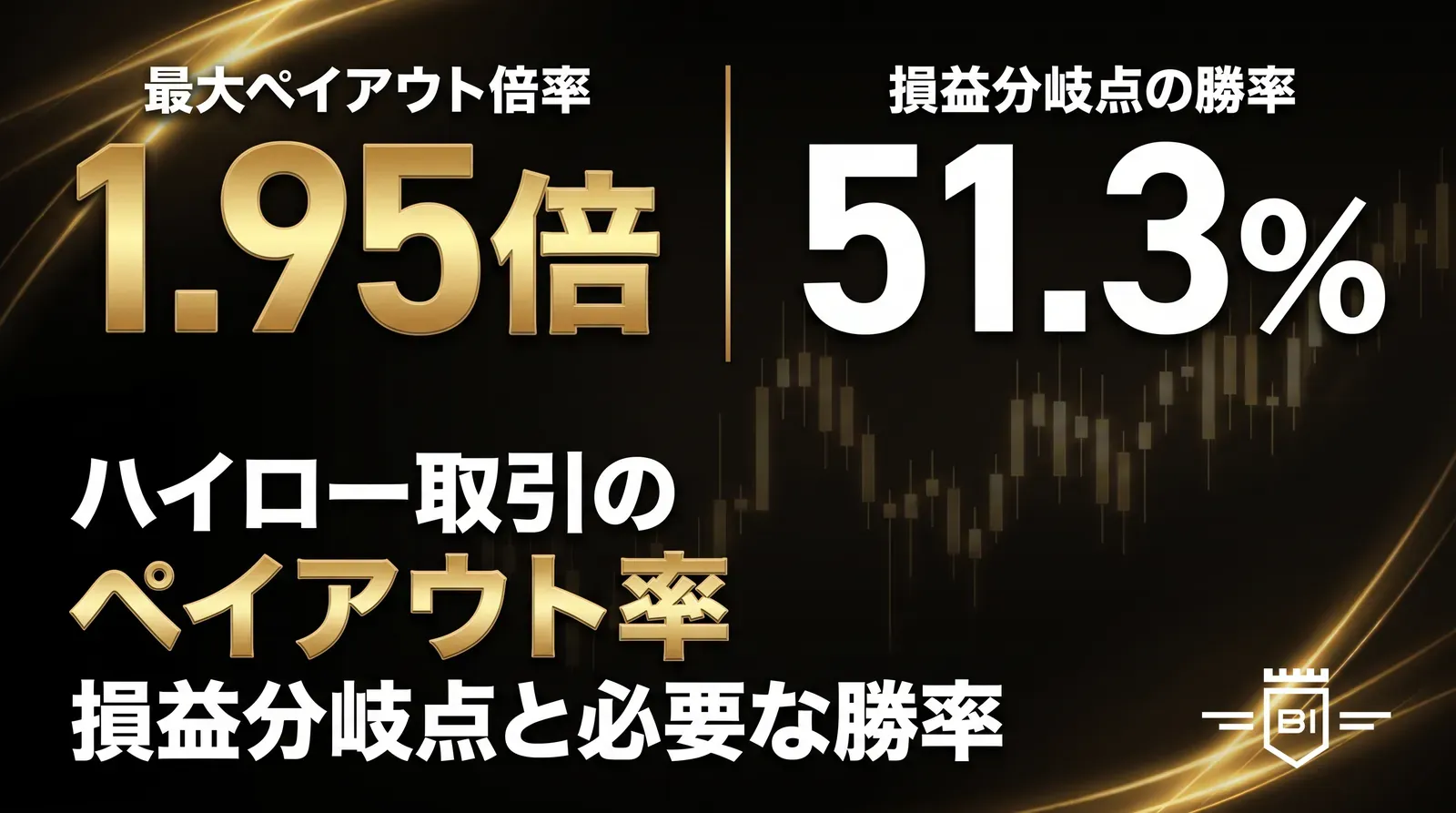
This article explains how to read the High/Low payout rate and the win rate you need to keep a profit at that multiplier. The break-even point is calculated as 100 ÷ payout multiplier, and a quick-reference table covers required win rates from 1.80x to 1.95x. It also covers why the payout multiplier varies and how to check it, how to count trades that end in a tie, and how to calculate the expected value per trade.
Try a free demo now
Experience the real trading environment without using real money
The payout rate in High/Low trading is the number that shows how many times your investment comes back when your prediction is correct. Even on the same 1,000 yen trade, the amount you get back differs by 150 yen depending on whether the multiplier is 1.80x or 1.95x.
At Bi-Winning, this multiplier varies with the asset and market conditions, and it reaches a maximum of 1.95x (95%). Once the multiplier is set, the win rate you need to avoid a loss can be calculated too. Even when trading at the maximum of 1.95x, your results will be negative if your win rate falls below 51.3%.
This article explains everything from how to read the payout rate to how to work out the win rate you need to stay profitable at that multiplier. Note that the calculation examples in this article assume trades held until the judgment time.
The Payout Rate Determines the Payout Amount
The amount you receive when your prediction is correct is found by multiplying your investment by the payout multiplier.
Investment × Payout Multiplier = Payout Amount
This payout amount includes the money you originally invested. That means your actual profit is what remains after subtracting the investment from the payout amount. If you trade 1,000 yen at 1.85x, it works out as follows.
1,000 yen × 1.85x = 1,850 yen (850 yen profit)
On the same 1,000 yen trade, the profit is 950 yen at 1.95x and 800 yen at 1.80x. Even a difference of just 0.05 in the multiplier translates into a 50 yen difference in profit per trade.
How to Read the Percentage Notation
The payout rate is sometimes written as a percentage, such as "95%." This percentage does not represent the entire amount returned. It shows what portion of the investment the profit amounts to. That is why you get the percentage by subtracting 1 (the amount you invested) from the multiplier.
1.95x − 1 = 0.95 (95%)
"95%" and "1.95x" are simply different ways of writing the same condition. In this article, we use the multiplier notation, which lets you calculate the payout amount directly.
When You Lose, the Entire Investment Is Lost
If your prediction is wrong, the amount you invested is not returned. On the other hand, you can lose only up to the amount you invested, so you will never be billed for more, no matter how far the market moves against you.
If you trade 1,000 yen at 1.85x, you gain 850 yen when you win and lose 1,000 yen when you lose. Because the amount you lose is larger than the amount you gain, your funds gradually shrink if your wins and losses are evenly split.
The Payout Rate Is Not Fixed; It Varies
The multiplier shown on the Bi-Winning trading screen varies with the asset, market conditions, and other factors. Even if an asset showed 1.90x on your previous trade, it will not necessarily show the same multiplier next time.
If the multiplier were fixed, it would be possible to make a table by judgment time, but that is not possible with a variable system. Even if you choose the same asset and the same judgment time, the number shown changes depending on when you enter. The most reliable way to find the multiplier is to check the number on the screen each time you trade.

Factors That Change the Payout Rate
There are four main factors that move the multiplier. The first is which asset you choose. The multiplier differs by asset, such as currency pairs, stock indices, cryptocurrencies, and stocks, so when you trade an asset you do not usually trade, check the number on the screen instead of relying on a multiplier you saw before.
Next is the judgment time. Even for the same asset, the displayed multiplier changes when you change the judgment time, and the range of available judgment times also differs by asset. If you compare the multiplier at several judgment times, you can see which conditions are easiest to trade for that asset.
The third is the market conditions at the time. When the market is moving sharply, the displayed multiplier can differ from usual even for the same asset. The multiplier may have changed from a few minutes earlier while you were watching the chart, so check the number once more right before you place your order.
The last is the trade type. In addition to High/Low trading, Bi-Winning also offers Turbo trading, and even for the same asset, the multiplier changes depending on which one you use to place your order.
Break-Even Is Found with 100 ÷ Payout Multiplier
Once you know the payout multiplier, you can calculate the win rate you need to avoid a loss yourself. Dividing 100 by the payout multiplier gives you the win rate at which your results are exactly zero.
100 ÷ Payout Multiplier = Break-Even Win Rate (%)
For example, when trading at 1.85x, it works out as follows.
100 ÷ 1.85 = approx. 54.1 (%)
If you made 100 trades, you would break even after winning about 54 of them. If you win fewer times than that, your funds will keep shrinking the more you trade.
Required Win Rate by Payout Rate
Payout Amount and Required Win Rate by Bi-Winning Payout Multiplier (1,000 Yen Investment)
Payout Multiplier | Payout Amount | Break-Even Win Rate |
|---|---|---|
1.80x | 1,800 yen | Approx. 55.6% |
1.85x | 1,850 yen | Approx. 54.1% |
1.90x | 1,900 yen | Approx. 52.6% |
1.95x | 1,950 yen | Approx. 51.3% |
This table is calculated on the assumption that you lose the entire investment on a losing trade. Each 0.05 increase in the multiplier lowers the required win rate by about 1.4 percentage points, so comparing 1.80x with 1.95x gives a difference of 4.3 percentage points.
A 50% Win Rate Leaves No Profit
High/Low trading is about predicting whether the price will go up or down, so your chance of being right seems to be 50-50. However, as long as the payout multiplier is below 2.00x, a 50% win rate results in a loss.
Suppose you make 100 trades of 1,000 yen each at 1.85x and go 50 wins and 50 losses. The amount you receive back is as follows.
50 trades × 1,850 yen = 92,500 yen
The total investment for 100 trades is 100,000 yen, so you end up 7,500 yen in the red. Even if the multiplier were the maximum of 1.95x, you would still be 2,500 yen short with 50 wins and 50 losses.
The Gap from 2.00x Is the Trading Cost
High/Low trading has no separate trading commission. Instead, the amount by which the payout multiplier falls short of 2.00x serves as the effective trading cost. You can estimate the cost per trade with the following formula.
(2.00 − Payout Multiplier) ÷ 2 = Estimated Cost per Trade (%)
Applied to a 1.85x trade, it looks like this.
(2.00 − 1.85) ÷ 2 = 0.075 (7.5%)
With a 1,000 yen investment, that works out to a cost of 75 yen per trade. If the multiplier rises to 1.95x, the cost falls to 2.5%, which is just 25 yen on the same 1,000 yen trade.
Hitting Break-Even Exactly Gives You Zero Profit or Loss
The break-even point is not where profit begins; it is where your results are exactly zero. Let's calculate a case with 54 wins and 46 losses at 1.85x.
54 trades × 1,850 yen = 99,900 yen
This is 100 yen short of the 100,000 yen investment, so you are almost exactly at zero. If you add one more win for 55 wins and 45 losses, the payout amount rises to 101,750 yen, and you finally come out 1,750 yen ahead.
With a win rate right at the break-even point, almost no profit remains. When thinking about the win rate you need, it is a good idea to aim for a level several percentage points above the break-even point.

Working Backward from Your Win Rate to the Required Multiplier
Conversely, if you know your own win rate, you can use the break-even formula in reverse. Dividing 100 by your win rate gives the multiplier you need to avoid a loss at that win rate.
100 ÷ Win Rate (%) = Required Payout Multiplier
For a win rate of 52%, it works out as follows.
100 ÷ 52 = approx. 1.92 (x)
Knowing this number lets you decide in advance at which multiplier you will enter. With a 52% win rate, for example, you would enter when the display shows 1.95x and pass when it shows 1.90x. Since the multiplier varies, an asset you passed on may have different conditions when you look at it again after some time.
Don't Choose Assets by Multiplier Alone
However, choosing a trade with a high multiplier does not mean you will win more often. What determines your win rate is how well you can read the price movements of that asset.
Even if a high multiplier appears on an asset you do not usually follow, you cannot always enter with solid reasoning. Even if the required win rate drops, your results will get worse if your own win rate drops by more than that.
Calculating the Expected Value per Trade
Once you know your win rate and the payout multiplier, you can also calculate the expected value of a single trade. Expected value is the number that shows how much you gain or lose on average per trade when you repeat trades under the same conditions many times.
Investment × (Win Rate × Payout Multiplier − 1) = Expected Value per Trade
Let's calculate it for a 1,000 yen trade with a payout multiplier of 1.85x and a win rate of 55%.
1,000 yen × (0.55 × 1.85 − 1) = 17.5 yen
That is a gain of 17.5 yen per trade, so repeating it 100 times adds up to 1,750 yen. However, if the win rate drops to 53%, the same formula turns negative.
1,000 yen × (0.53 × 1.85 − 1) = −19.5 yen
A difference of just 2 percentage points in win rate flips the result from positive to negative. This is because, in a 1.85x trade, each percentage point of win rate moves the expected value per trade by 18.5 yen.
Trades That End in a Tie Don't Count Toward Your Win Rate
At Bi-Winning, if the price at entry and the price at judgment are the same, the investment is refunded as is. Because this trade is neither a win nor a loss, you exclude it from the denominator when counting your win rate.
If 4 out of 100 trades ended in a tie, you would check whether you are above the break-even point over the remaining 96. In a period with many ties, the number of trades in which profit or loss actually moved is smaller than the apparent number of trades.
Note that a refund on a tie does not lower the win rate you need. That trade simply has zero profit or loss, so the win rate required of your other trades does not change.
The More You Trade, the Closer Results Get to the Expected Value
The required win rate calculations so far apply when you repeat trades a sufficient number of times. While the number of trades is small, chance deviations can make your win rate swing widely.
Even if you win 6 out of 10 trades, that alone does not mean the method's win rate is 60%. A method with a 50% win rate can win 7 out of 10, and a method that is only slightly above break-even can lose money over a short period. So when checking your own win rate, tally it after you have accumulated a reasonable number of trades.
The Payout Rate Stays the Same Even If You Change the Investment Amount
The investment amount for High/Low trading at Bi-Winning ranges from a minimum of 500 yen to a maximum of 200,000 yen per trade. The payout multiplier is a number applied to your investment, so the multiplier itself does not change no matter how much you invest. At 1.85x, a 500 yen trade pays out 925 yen, and a 200,000 yen trade, the maximum, pays out 370,000 yen.
A larger amount means a larger payout, but the required win rate stays the same. At the same time, the amount you lose when you are wrong also grows in proportion to your investment.
Trades Sold Early Are Not Covered by This Calculation
Bi-Winning offers trades in which you can sell your position without waiting for the judgment time. However, the payout amounts and break-even points calculated so far assume trades held until the judgment time.
If you mix in trades that were sold early when tallying results, you cannot judge correctly even by comparing against the required win rate. When checking your win rate and multiplier, collect only the trades held until judgment.
Checking the Payout Rate on the Trading Screen
The payout multiplier is displayed at the top of the order area once you select an asset and a judgment time. Because the multiplier varies, the number that applies to your trade is the one displayed right before you enter.
Switching the asset or judgment time may change the multiplier as well. Since Bi-Winning confirms an order with a single click by default, get into the habit of checking the multiplier before you press the button.
If you would like to start with how to read the order screen, please see the following article.

Tally Your Win Rate from Your Trade History
You can calculate your own win rate, to compare against the required win rate, from the transaction history in My Page. If you specify a period, you can review the records of the trades you made during that time all at once.
Number of Wins ÷ Number of Trades × 100 = Win Rate (%)
Check whether the win rate you get exceeds the break-even point for the multiplier you usually trade at. Here too, calculate with trades that were refunded as ties excluded from the number of trades.
When Multipliers or Amounts Vary, Look at Profit and Loss
The calculations so far assume that you trade the same amount at the same multiplier every time. In actual trading, the multiplier changes with each entry, and you may also change the amount you invest.
For example, if most of your winning trades were at low multipliers, your results can be negative even when your win rate exceeds the break-even point for the multiplier you usually see. The same goes for varying your investment amount: if your losing trades involve larger amounts, your results will not add up.
For that reason, when multipliers and amounts are not uniform, compare using total amounts rather than win rate.
Total Payout Amount − Total Investment = Profit/Loss for the Period
Use your win rate as a guide when reviewing your method, and check with amounts to see whether your funds are actually growing.
Set Your Stake Based on the Payout Rate
Even if you have a method that beats the required win rate, a large stake per trade can wipe out your funds in a losing streak. Once you have worked out the required win rate from the payout multiplier, the next step is to decide your stake per trade.
If you want a guideline for stake size, it is explained in the following article, so please take a look.

Frequently Asked Questions
Q. How high can the payout rate go?
A. The maximum payout multiplier at Bi-Winning is 1.95x (95%). However, the multiplier varies from trade to trade, so you cannot always trade at 1.95x.
Q. Does the payout rate change after I enter?
A. The multiplier that applies is the one displayed at the moment you entered. Even if the multiplier on the screen moves afterward, the payout amount of a trade you are holding does not change.
Q. What should I do when the payout rate is low?
A. The lower the multiplier, the higher the win rate you need to avoid a loss. The multiplier may change if you switch the asset or judgment time, so rather than forcing an entry, compare the displayed multiplier with your own win rate before deciding.
Q. If I am above the break-even point, will I make a profit?
A. The break-even point is a guideline for when you repeat trades a sufficient number of times. While the number of trades is small, you may not make a profit even if your win rate is above the break-even point.
Q. Can I check the payout rate in demo trading too?
A. Yes, you can check the payout multiplier on the order screen in demo trading as well. If you want to try out how the multiplier changes, it is a good idea to look at the actual screen in demo trading.
Summary
The payout rate in High/Low trading is the multiplier that determines the payout amount, and the break-even win rate is found with 100 ÷ payout multiplier. As long as the multiplier is below 2.00x, a 50% win rate results in a loss, so it is important to see how far your own win rate exceeds the break-even point.
Bi-Winning's multiplier is variable, with an upper limit of 1.95x. Since there is no fixed table, check the number on the trading screen before you enter. You can tally your own win rate from the transaction history in My Page, so compare it with the required win rate.
If you would like to review the trading flow from the beginning, please see the following article.

Experience the Bi-Winning trading platform risk-free
Try the Bi-Winning trading platform for free right now. No registration required to try High/Low trading. Your demo account comes with 100,000 JPY in virtual funds.
Try a free demo now
Experience the real trading environment without using real money
Company Information
Providing a safe, secure, and comfortable trading environment for all investors.
| Company | Alpha Options LLC |
| Location | Euro House, Richmond Hill Road, Kingstown, St. Vincent and the Grenadines |
| Support Hours | 10:00 – 17:00 (JST)Excluding weekends, holidays, and year-end closures |
| Business Succession | Succeeded from BET GLOBAL MARKET INC. on February 7, 2025 |
| Contact | Contact Us |
| Official Twitter | https://x.com/BIWINNING1 |
関連記事

At What Income Do You Need to File a Tax Return for High/Low Trading? Tax Calculation and Residence Tax Notes
This article explains at what income a tax return is needed for High/Low trading and how tax is calculated, with guidelines for employees, students and sole proprietors, 2026 rates, residence tax, and how to file.

Where Can You Try a High/Low Demo? How to Start a Free Demo With No Registration
The HighLow Australia demo is no longer available, but you can still try High/Low trading on a free demo. This article covers how current demos differ, four points to check, and how to start the Bi-Winning demo.

Looking for an alternative to HighLow Australia? Comparing where to move after the closure [2026]
HighLow Australia ended its service on June 30, 2025. This article compares replacement brokers by minimum deposit, withdrawal guideline, and trading conditions, and covers Bi-Winning’s operating information.