At What Income Do You Need to File a Tax Return for High/Low Trading? Tax Calculation and Residence Tax Notes

This article explains at what income a tax return is needed for High/Low trading and how tax is calculated, with guidelines for employees, students and sole proprietors, 2026 rates, residence tax, and how to file.
Try a free demo now
Experience the real trading environment without using real money
If you make a profit from High/Low trading, you generally report it as miscellaneous income in your tax return.
For company employees, a tax return is generally required once income other than salary and retirement income, including High/Low trading, exceeds 200,000 yen per year.
This article walks through, in order, the income level at which a tax return becomes necessary, tax rates, how to calculate your profit, and how to prepare the return.
The deduction amounts introduced in this article are based on filing in 2027 for income earned in the 2026 tax year.
Even when you do not need to file an income tax return, you may still need to file a residence tax return. It is handled separately from the income tax return, so be careful.
Also, what is taxed is the profit or loss of trades whose results have been determined. Even if you have not withdrawn your profit from your account, a determined profit is counted as income for that year.
Note that from the 2026 tax year, the income requirements for the basic deduction, dependent deduction and spouse deduction have changed. When you file, check against the 2026 criteria.
Report High/Low trading profits as miscellaneous income
The profit you report is calculated by taking the payouts you received during the year and subtracting the amounts you used for that year's trades and necessary expenses.
Profits from High/Low trading through an overseas broker are, in principle, subject to aggregate taxation, under which your tax is calculated by combining them with income such as salary.
On the other hand, trades with a broker registered in Japan may be subject to separate self-assessment taxation.
At what income level is a tax return required?
The amount at which a tax return becomes necessary differs depending on whether you are a company employee, a student or homemaker, or a sole proprietor.
The benchmark here is not the amount you received itself, but your "income" after subtracting necessary expenses.

If you are a company employee
The benchmark is whether your total income other than salary exceeds 200,000 yen per year.
However, this 200,000 yen benchmark applies as is only to people who meet certain conditions, such as receiving salary from one employer and having completed the year-end adjustment.
The treatment is different if you receive salary from two or more employers, or if your salary income exceeds 20,000,000 yen per year.
Also, if you file a tax return for another reason, such as the medical expense deduction or the first year of the housing loan deduction, you include High/Low trading income in the return even if it is 200,000 yen or less.
If you have no salary, such as a student or homemaker
The company employee "200,000 yen" benchmark does not apply to people who do not receive salary.
You judge by subtracting income deductions such as the basic deduction from your income, including High/Low trading, and checking whether any tax arises.
For the 2026 tax year, the basic deduction is 1,040,000 yen when your total income is 4,890,000 yen or less. If you have no other income or deductions, whether your High/Low trading income exceeds this amount serves as one guideline.
If you have salary from a part-time job or similar, check your salary income and High/Low trading income together.
If you are a sole proprietor or freelancer
If you are a sole proprietor or freelancer and already file a tax return every year, include High/Low trading income in your return as well.
The company employee rule that "no return is needed if income other than salary is 200,000 yen or less" cannot be applied as is.
Also, because High/Low trading profits and losses are in principle treated as miscellaneous income, you cannot deduct losses from trading from your business income profits.
High/Low trading profits also affect your dependent status
If you are a dependent of a family member, you need to pay attention to your income amount when you make a profit from High/Low trading.
When determining the dependent deduction, spouse deduction and similar, miscellaneous income from High/Low trading is included in total income.
For that reason, if your annual income exceeds a certain amount because of High/Low trading profits, you may no longer qualify for the dependent deduction or spouse deduction.
Total income requirements judged including High/Low trading profits (2026 tax year)
Name of deduction | Eligible total income |
|---|---|
Dependent deduction | 620,000 yen or less |
Spouse deduction | 620,000 yen or less |
Special spouse deduction | More than 620,000 yen and up to 1,330,000 yen |
Special deduction for specified relatives | More than 620,000 yen and up to 1,230,000 yen |
From the 2026 tax year, the income requirement used to determine the dependent deduction and similar deductions has changed to 620,000 yen or less.
If your income is salary only, adding the minimum salary income deduction of 740,000 yen gives an annual salary of 1,360,000 yen as one guideline.
For example, if a student's annual income reaches 700,000 yen, it exceeds 620,000 yen, so the student may no longer qualify as a dependent for the parents' dependent deduction.
However, if the student is aged 19 or older and under 23, the student may qualify for the special deduction for specified relatives as long as total income is 1,230,000 yen or less. If this applies to you, check at the year-end adjustment conducted by your parents' employer.
Note that what is explained here is dependent status for tax purposes. Health insurance dependents have separate criteria, so check with the health insurance plan you belong to as well.
What is the tax rate on High/Low trading? Income tax is 5% to 45%
Profits from High/Low trading through an overseas broker are, in principle, treated as miscellaneous income under aggregate taxation, and the income tax rate is 5% to 45%.
However, the tax rate is not determined by your High/Low trading profit alone.
The rate is determined by your taxable income, which is your income combined with other income such as salary, minus income deductions.
Income tax rates and deduction amounts (2026 tax year)
Taxable income | Tax rate | Deduction amount |
|---|---|---|
Less than 1,950,000 yen | 5% | 0 yen |
1,950,000 yen or more but less than 3,300,000 yen | 10% | 97,500 yen |
3,300,000 yen or more but less than 6,950,000 yen | 20% | 427,500 yen |
6,950,000 yen or more but less than 9,000,000 yen | 23% | 636,000 yen |
9,000,000 yen or more but less than 18,000,000 yen | 33% | 1,536,000 yen |
18,000,000 yen or more but less than 40,000,000 yen | 40% | 2,796,000 yen |
40,000,000 yen or more | 45% | 4,796,000 yen |
Income tax is calculated by multiplying taxable income by the tax rate and then subtracting the deduction amount.
For example, if taxable income is 3,000,000 yen, the calculation is 3,000,000 yen × 10% − 97,500 yen = 202,500 yen.
The tax you actually pay includes the special income tax for reconstruction in addition to this income tax. Residence tax is also calculated separately and is paid in the following fiscal year based on the contents of your tax return.
How is High/Low trading income calculated?
In a tax return, you total the profit and loss of trades whose results were determined from January 1 to December 31.
The amount left after subtracting necessary expenses from that total is the income you report.
Look at your profit and loss for the year, not your account balance
You do not report the amount remaining in your account or the amount you actually withdrew as income as is.
This is because your account balance may include funds you deposited yourself and bonuses.
In a tax return, you calculate based on the profit and loss of trades determined during the year, not on your account balance.
Losing trades are included in the calculation
You do not total only the trades that made a profit.
If you had losing trades in the same year, those losses are also included when calculating your profit or loss for the year.
Necessary expenses are then subtracted to arrive at your final income amount.

Tax applies when the result is determined
In High/Low trading, profit or loss is decided when the expiry time arrives and the win or loss is determined.
For that reason, in tax calculations it is treated as income for the year in which the result was determined.
It counts as income even if you have not withdrawn it
Even if you leave your profit in your account, it is included in that year's income as long as the result has been determined.
The year in which it is taxed does not change depending on whether you actually withdrew it.
For trades that span years, go by the determination date
Even if you start a trade in December, if the result is determined in the following year, it is treated as profit or loss for the following year.
If you trade near the end of the year, check the determination date, not the purchase date.
Even if your income is 200,000 yen or less, you may need to file a residence tax return
The company employee rule that "no tax return is needed if income other than salary is 200,000 yen or less" applies to income tax.
Residence tax has no such benchmark, so even if you do not file an income tax return, you may need to file a residence tax return.
If you file a tax return, no residence tax return is needed
When you file an income tax return, its contents are also shared with your city, ward, town or village.
For that reason, you normally do not need to file a residence tax return separately.
On the other hand, if you do not file an income tax return, you may need to file a residence tax return at the municipality where you live.
Also check how you will pay residence tax
The tax return form has a field where you can choose, for residence tax on income other than salary and public pensions, whether it is deducted from your salary by your employer or paid by yourself.
If you want to pay the portion from High/Low trading separately from your salary, check this item when you file.
What to prepare before filing a tax return
Having the following documents ready in advance makes things go smoothly.
- Trading history for the full year
- Withholding tax slip
- Certificates required for various deductions
- Receipts for expenses you will claim
- Documents that confirm your My Number
- Account details for paying tax or receiving a refund
When you do High/Low trading through an overseas broker, an annual trading report may not be issued.
In that case, you total your profit and loss for the full year yourself based on your account's trading history.
Taxation differs between domestic and overseas brokers
The tax treatment of High/Low trading changes depending on the broker you use.
Certain trades with a broker registered in Japan are subject to separate self-assessment taxation, but trades through an overseas broker are, in principle, treated as miscellaneous income under aggregate taxation.
For that reason, even for the same High/Low trading, the tax rate and the treatment of losses differ depending on which broker you use.

Differences in tax category between domestic and overseas brokers
Point of comparison | Registered domestic broker | Other brokers |
|---|---|---|
Taxation method | Separate self-assessment taxation | Aggregate taxation |
Tax rate | Income tax 15% + local tax 5% | Income tax 5% to 45% + residence tax 10% |
Offsetting losses against profits | Can be offset within futures trading income | Can be offset only within miscellaneous income |
Loss carryforward | Can be carried forward for 3 years from the following year under certain conditions | Not eligible for this carryforward |
Under either tax category, the special income tax for reconstruction applies in addition to income tax.
If you use multiple brokers, total aggregate taxation and separate self-assessment taxation separately.
The overall approach to taxes on binary options is explained in the article below.

What happens in a year with a loss?
If your High/Low trading for the year ends in the red, you basically do not need to file a tax return on the grounds of that loss alone.
This is because losses from trades through an overseas broker cannot be deducted from other income such as salary income, and cannot be carried forward to following years.
However, if you have other income that falls under the same miscellaneous income, you may be able to combine profits and losses.
Also, even if an income tax return is not needed, you may need to file a residence tax return.
For trades subject to separate self-assessment taxation, such as trades with a registered domestic broker, there is a system that lets you carry losses forward to following years if you meet certain conditions.
To use this carryforward, you must continue to file a tax return every year starting from the year the loss occurred.
What can be claimed as an expense in High/Low trading
Costs you paid for High/Low trading may be deducted from your profit as necessary expenses.
For example, the following costs.
- Communication charges used for trading
- Costs of books and seminars related to trading
- The portion of a PC or peripheral equipment used for trading
- Fees for trading tools and paid information services
For smartphones, PCs and similar items that you also use privately, the full purchase cost cannot always be claimed as an expense as is.
Keep records of how you use them and receipts so that you can calculate the share used for trading separately.
If it is hard to judge whether something qualifies as an expense, we recommend checking with your tax office or a tax accountant.
How to prepare a tax return
You can prepare a tax return from a PC or smartphone using the National Tax Agency's "Tax Return Preparation Corner."
Once you enter the required amounts, the tax is calculated automatically, and you can submit the completed return through e-Tax.

Steps for entering information in the Preparation Corner
The basic flow is as follows.
- Select the income tax return and set your submission method
- Select "Miscellaneous (business/other)" for the income you are reporting
- If you are a company employee, enter the details of your withholding tax slip
- Enter your High/Low trading revenue and necessary expenses
- Enter your income deductions, check the tax amount, and submit
Whether you enter High/Low trading income under "business" or "other" may change depending on the scale and continuity of your trading and other factors.
Also, how to enter payouts and purchase amounts may need to be confirmed depending on how you total your trading history.
If you are unsure, do not decide on your own; check with your tax office or a tax accountant.
If you file by hand
When you prepare a return by hand, you also basically calculate miscellaneous income from your revenue and necessary expenses for the year.
The fields you fill in differ depending on whether you report miscellaneous income as "business" or "other."
With e-Tax, the necessary fields appear according to what you enter, so first-time filers will find it easier to use the Preparation Corner.
Filing deadline and submission methods
For the 2026 tax year, the income tax return filing period runs from February 16 to March 15, 2027.
You can submit through e-Tax, or bring or mail the return to the tax office.
The payment deadline is also, in principle, the same as the filing deadline. If you use automatic transfer payment, the amount is debited from your account on the designated date.
If you do not file a tax return
If you needed to file but did not complete the procedure by the deadline, additional tax for failure to file and delinquency tax may apply on top of the tax you originally owed.
The additional amount varies depending on when you file, the amount of tax, whether you filed before the tax office pointed it out, and so on.
If you notice you missed a filing, do not leave it; file a late return and pay the tax as soon as possible.
If certain conditions are met, there are cases in which additional tax for failure to file does not apply.
How to check your trading history on Bi-Winning
On Bi-Winning, you can check records of trades and deposits and withdrawals from "Transaction History" in My Page.
The trading history on the "History" tab shows items such as date, trade ID, credit, debit, investment amount and account balance.
You can also narrow it down by period, so when checking for a tax return, setting January 1 to December 31 lets you view the full year's history.
You can save the records you need from "Report Download."
Note that the totals shown at the top of the screen also include amounts other than trading, such as deposits, withdrawals and bonuses.
When calculating profit and loss for your tax return, do not look only at your account balance; check that year's profit and loss based on your trading history.
How to use Bi-Winning's trading screen and My Page is also explained in detail in the article below.

Frequently asked questions
How do I calculate if I trade with multiple brokers?
If the trades fall under the same miscellaneous income under aggregate taxation, you can calculate profit and loss across multiple brokers together.
On the other hand, trades subject to separate self-assessment taxation are in a different tax category, so total them separately.
Can I file High/Low trading profits as a blue return?
Blue return filing applies to real estate income, business income and forestry income.
If High/Low trading profits are treated as miscellaneous income, they are basically not eligible for a blue return.
If you want to understand how High/Low trading works in the first place, please also see the article below.

Summary
In a High/Low trading tax return, what matters is to calculate your income based on the profit and loss of trades determined during the year, not on your account balance or withdrawal amounts.
For company employees, whether income other than salary and retirement income exceeds 200,000 yen per year is one guideline for whether a tax return is needed.
On the other hand, if you have no salary or are a dependent, you need to judge including the basic deduction and other factors.
On Bi-Winning, you can check your trading history by specifying a period from "Transaction History" in My Page. When preparing for your tax return, saving the full year's records early makes them easier to check.
If you are about to start High/Low trading, please also see the article below.

Experience the Bi-Winning trading platform risk-free
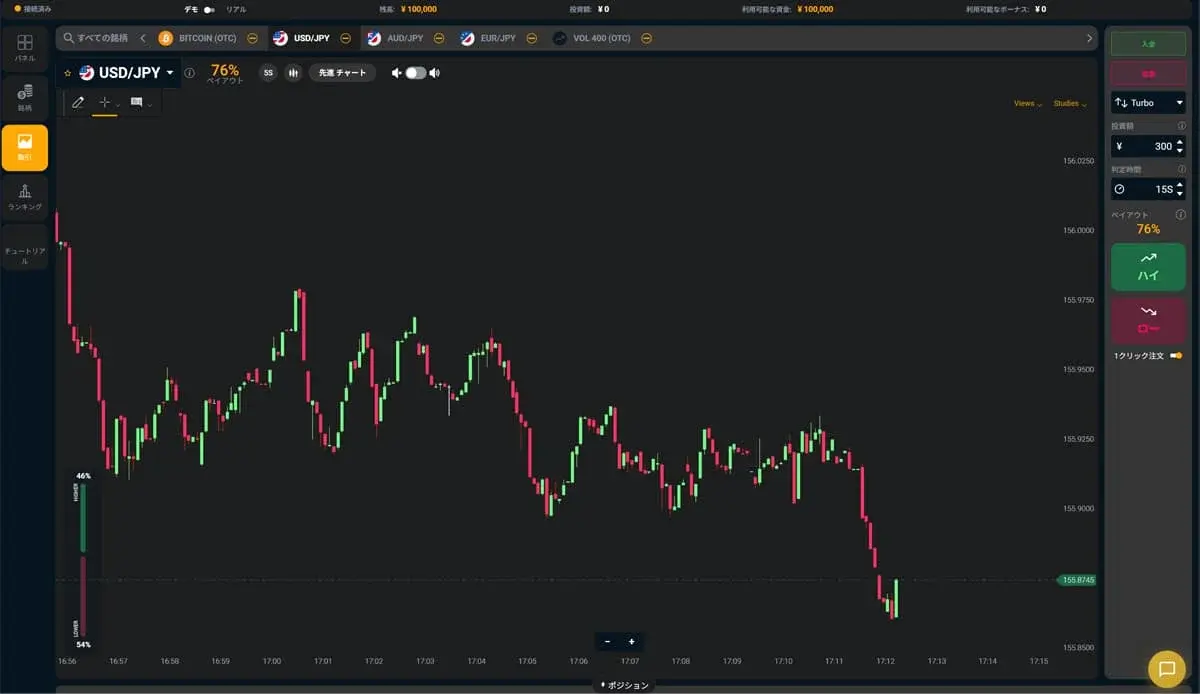
Try the Bi-Winning trading platform for free right now. No registration required to try High/Low trading. Your demo account comes with 100,000 JPY in virtual funds.
Try a free demo now
Experience the real trading environment without using real money
Company Information
Providing a safe, secure, and comfortable trading environment for all investors.
| Company | Alpha Options LLC |
| Location | Euro House, Richmond Hill Road, Kingstown, St. Vincent and the Grenadines |
| Support Hours | 10:00 – 17:00 (JST)Excluding weekends, holidays, and year-end closures |
| Business Succession | Succeeded from BET GLOBAL MARKET INC. on February 7, 2025 |
| Contact | Contact Us |
| Official Twitter | https://x.com/BIWINNING1 |
関連記事
What Is the Payout Rate in High/Low Trading? Break-Even Points and Required Win Rates by Multiplier
This article explains how to read the High/Low payout rate and the win rate you need to keep a profit at that multiplier. The break-even point is calculated as 100 ÷ payout multiplier, and a quick-reference table covers required win rates from 1.80x to 1.95x. It also covers why the payout multiplier varies and how to check it, how to count trades that end in a tie, and how to calculate the expected value per trade.

Where Can You Try a High/Low Demo? How to Start a Free Demo With No Registration
The HighLow Australia demo is no longer available, but you can still try High/Low trading on a free demo. This article covers how current demos differ, four points to check, and how to start the Bi-Winning demo.

Looking for an alternative to HighLow Australia? Comparing where to move after the closure [2026]
HighLow Australia ended its service on June 30, 2025. This article compares replacement brokers by minimum deposit, withdrawal guideline, and trading conditions, and covers Bi-Winning’s operating information.